
Bhoota Aradhane: The wee hours when the Numen Swoop Down & saunter among the Homosapians
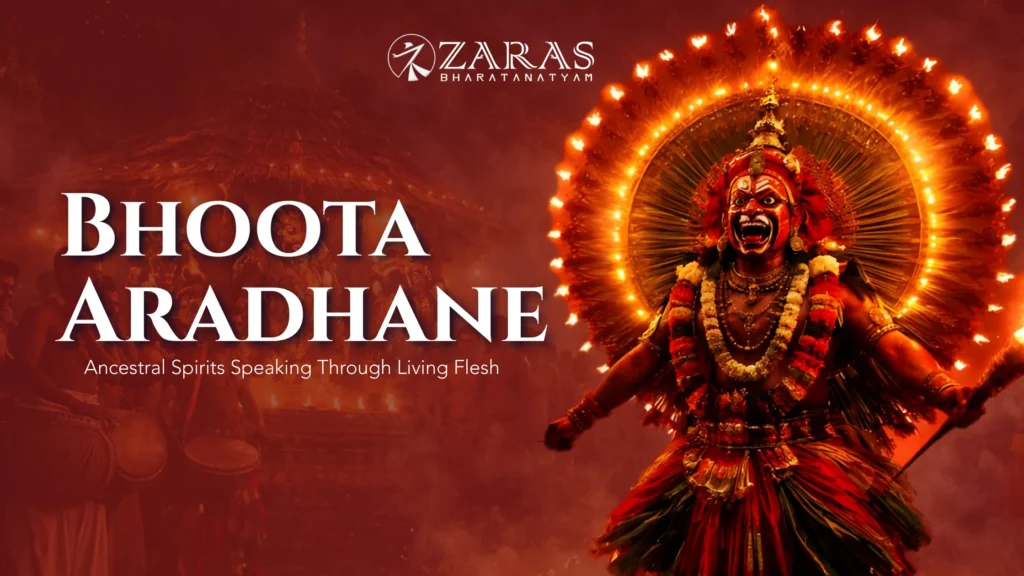
Bhoota Aradhane colloquially and locally known as Bhoota Kola or Nema, is a conventionalized and overwrought ceremonial dance and spirit conjuration and incantation from Tulu Nadu region the locales of maritime Karnataka and some milieus of Kerala. Far from being a mere folk dance it’s an ethno spiritual occurrence where the parallelism between the man and God obfuscate,obscure and vague. As the Westerners misconstrue the bhootas are not demons but as contained in the Tulu chronological document, Bhootas are defined to be daivas, the sanctified beings always ready to come for instant necessary human succour and assistance.
There are three primordial purposes safeguarded by this sacrament, they are, security is ensured, righteousness is preserved and harmony is achieved through this dance.
It is trusted beyond doubt that the bhootas or daivams perpetually offered their devotees, cattle and crops full security from nefarious and depraved elements. The spirits through their clairvoyance and visions lull and ease down land strife and family rancor. Striking an equity and equanimity between nature and creature.
Though there are over 400 discrete spirits in the Tulu shrine , they are adeptly systematized and encapsulated into three main fountain heads. They are animal spirits, human heroes and puranic deities. The animal spirits are panjurli and pilichandi, heroic warriors who gave up their lives tragically like twin heroes koti and chennaya. Regional adaptation carved out from vedic Gods form Puranic deities such as Chamundi and Vishnumurthy.
A Bhoota Kola is usually enacted at night through a stringent punctilious solemn pattern and progression. The ceremony opens with vocalizing the paddanas – the verbal saga that depict the genesis, Odyssey and gallantry of the deity who is to be summoned and beseeched. The performer of this particular mystical feat is chosen from the Nalike, Pampada and parava communities.
They are subjected to gradual transformation and transfiguration by expanded and extensive facial paint featuring the hues like red and yellow and adorn an ensemble of palm foliage and red garb. The lilting cadence of gaggara during the performance indicates the advent of the daivam. A huge spherical Corona made of bamboo and garb is fixed in the back of the performer indicating the divine radiance, ring of light and nimbus of the deity possessed.
The performer enters into an ecstatic stupor as the beating of drums and the timbanum tearing shenai progress meticulously which proves the custody and occupancy of the body by the daivam. Once the Nema takes over the body the performer is no longer seen as a mere human. He speaks in a screeching and squeaking sound heeding to the agony and grievances of the rural people and offering resolutions and graces for the villagers. In most of the performance the dancers enact with Jeetige(fire torch) and strut on scorching blazing coal illustrating and substantiating the daivam’s omnipotence over corporeal ache.
Bhoota Aradhane has emerged as a celestial and mystical catalyst for establishing equality, fraternity and liberty irrespective of social echelons and grades.
