
Nandhi Dhwaja: The Regal Mass extravaganza and Hallowed Apex of Mysore Dasara(Jumboo Savari)
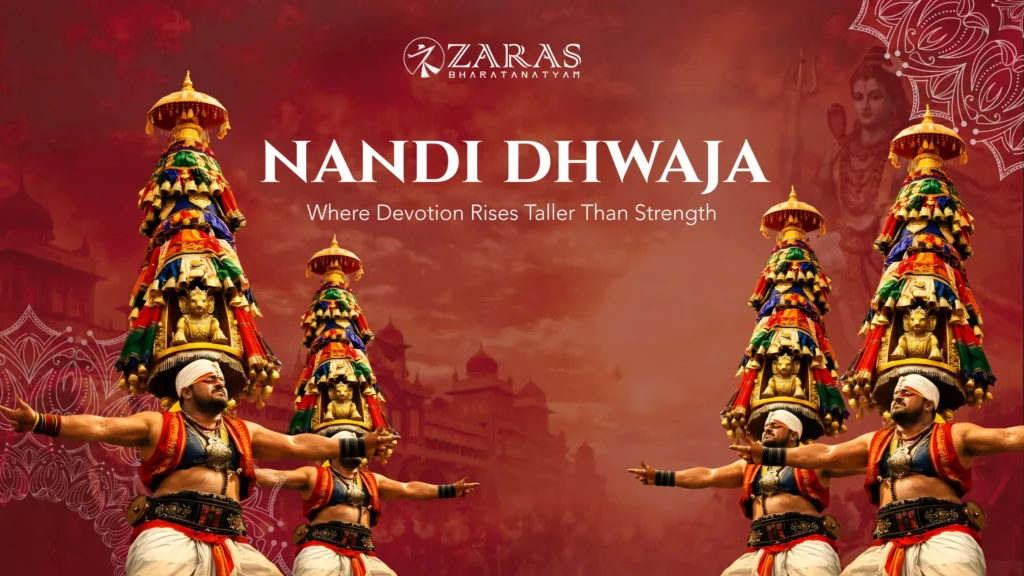
Nandhi Dhwaja is one of the most resplendent and magnificent folk art forms of Karnataka. It is optically dazzling and spiritually awe inspiring and piety filling. The dance is substantially connected and enrouted with the veerashaiva community and the adoration of Lord shiva. Moreover it is a dance form that demands great bodily exertion, resilience,equilibrium, and sanctity. The nandhi Dhwaja or nandhi flag or pole is deemed to be the indomitable triumph of Veerabhadhra (the ansh of shiva) over Daksha Brahma ( sati’s father). The mast signifies the Dhwaja of Nandhi, the celestial bull, the holy conveyance of Lord Shiva, personifying tenacity, robustness and never diminishing zeal.
The flag staff is usually perceived as the motif and emblem of triumph and sovereignty. It’s noteworthy that the Mysore Maharaja himself adores the Nandhi Dhwaja before the renowned Jumbu Savari Dusera Parade commences. Most vital component of this dance form is the mast itself , which is a tour de force of the loric adroitness and proficiency. It is a colossal gargantuan staff which sizes up to 20 to 25 feet in height. At the pedestal there is a minor brass or bronze sanctum like framework holding a portrait of Nandhi. The flagstaff is bedecked and bejeweled with silk garbs, brass rings and bells. The apex of the mast holds a kalasha and a chathri personifying the seraphic and hallowed spectre.
Because of all these massive paraphernalia and bearings and also the unusual length of the bamboo, the Flagstaff is awfully hefty and weighty which requires tremendous nucleic potency to maintain the equilibrium. The dance is a mono manifestation of maintaining equipoise and homeostasis of the enormous mast with a metrical and musical progression. The dancer fastens a distinctive leather girdle called Navara. The base of the heavy pole is ingrained in this pouch relocating the weight to the artist’s hips and legs. Inspite of the enormous heaviness the dancer executes adeptly and proficiently convoluted and rapid footsteps, with pirouetting and pulsating shifts. One vital aspect the dancer must be wary of is that the pole should never land on the ground which is considered as inauspicious and blasphemous to the deity.
The dance adopts variegated pattern of shift and fashion known as hejjes. They include ondu hejje, eradu hejje and daudu hejje. The dancers are subjected to certain systematic protective measures that incase of a staunch variation in wind and also during intricate whirls. The ambience and vibe of the performance are spirited and intrepid. The music is escorted by folkloric and customary percussive and wind instruments including karde, cymbals, shenai Nagaswara and dollu.
Even though Nandhi Dhwaja is the piece de resistance of Mysore Dasara. It is also performed during the propitious and felicitous occasion of jathre, mahashivratri and religious processions. This dance is not only a mere performance but a systematic yogic equipoise of corporeal and spiritual fervor. It always remains a peacock throne and a proud highlight of the old Mysore milieu.
