
Mystical Allure of Butta Bommalu: An exultant & Rapturous Veiled Pageant
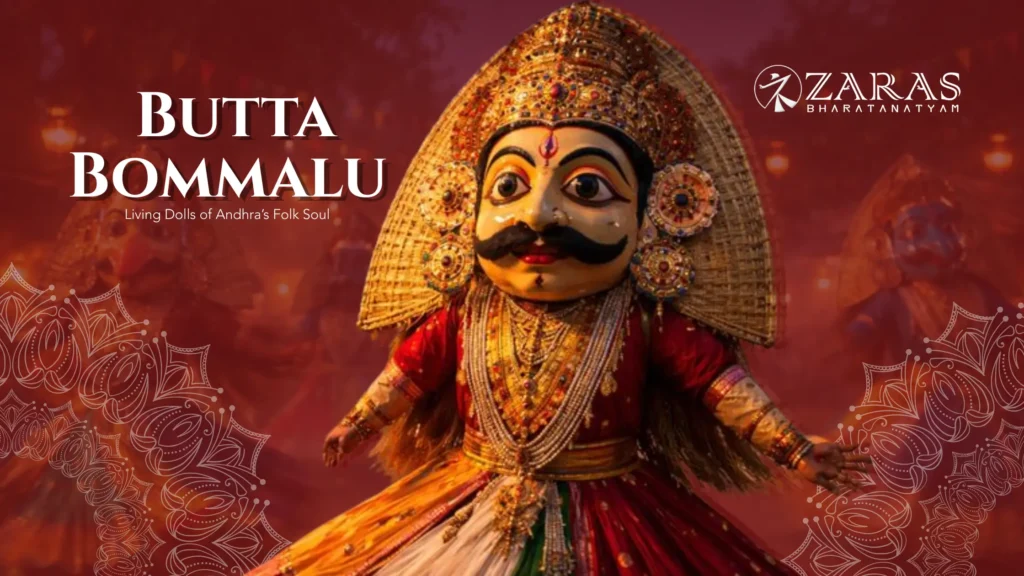
Butta Bommalu is a regional and ethnically folkloric dance that sprang forth from the suburbs of Andhra Pradesh, India. This dance form atavistically stemmed from the Tanuku region of West Godavari district, Andhra Pradesh. The term Butta Bommalu is translated as ‘basket dolls’ or ‘basket toys’. What’s rather captivating is the performers emulate the exact appearance and attire of the dolls through their garbs clad for the performance.
The artists ornate and embellish themselves with a massively humongous basket like mask . In the same way alluding to their garb, it is also quite queer. Materials used for fabricating the conventional wear are thin bamboo strips ( spun into an oval hollow structure),wooden husk,dry grass and a final fine tuning smearing of cow dung for the soft,tender ,delicate and climactic closure, which artistically bear a resemblance to basket toys. These figures bear a very ginormous and mammoth appearance which replicate the gargantuan walking puppets. Because of this outlandish and idiosyncratic regalia and paraphernalia, Butta Bommalu is rightly hailed as the dance of the masks. There is also another local spiel which binds this dance form with the demon king Taraksena who is supposed to have reigned over this minor kingdom.
The dancers smoothly glide inside ,the eight feet tall and three feet wide figurine, through the entrance at the bottom fastening and strapping tightly around their waist and shoulders. To bejewel this attire they fix the mask over the head embodying the character.
It is a Jamboree and jollification of exuberance, euphoria and ebullience. The dolls emblazingly powdered and rouged in magnificent and coruscating shades exhibit mythical and folkloric characters – Lord Krishna, Lord Shiva, Lord Rama, Parvati and Hanuman, in accordance with the respective bean feast concelebrated by the mileu.
What is so appealing and captivating about this performance is, it is organically clubbed with austere narration, through high octane non verbal histrionics. Adding to this the plot moves suavely and benignly through the radiant metrical movements and gesticulation of humongous masks.
In contrast to the capacious masks the action is so subtle, delicate and nimble, magnetically pulling the rapt attention of the audience which leaves them spell bound and dumbfounded. The dancers move to and fro harmoniously and elegantly generating a circle. The background score for the choreography is extended very unostentatiously with the time revered conventional percussion instruments like dappu, dhol and cymbals. These seemingly simple and austere instruments energetically and expansively generate arresting and mesmerizing music which goes in tune with the equivalent vigorous steps of the dancers.
No rigorous rehearsals or rigid practice is given to the dancers making It easily tangible and vincible to ordinary mob. The only mandatory element that leads to a perfect performance is keen scrutiny and circumspection.
As a befitting closing remark, buttabommalu is a high octane and vivacious art form with enormous masks and extensive regalia captures the undivided and undiverted focus of everyone especially kids making it a poise finesse and joyous visual gala which strewn the opulent and affluent pastoral and arcadic folk art legacy of Andhra Pradesh.
